
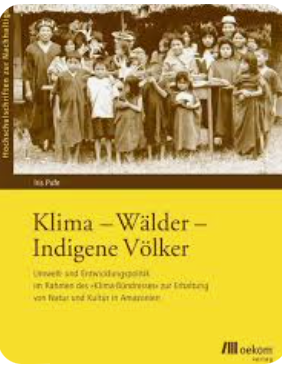
ENGL “Climate, forests, indigenous peoples”. Environmental and development policy within the framework of the ‘Climate Alliance’ for the conservation of nature and culture in the Amazon. Dissertation, academic publications on sustainability. ( Analysis of climate change impacts on indigenous peoples and tropical forests. Case study: “Climate Alliance” and the project “Munich–Asháninka.”)
Keywords: #GlobalJustice #IndigenousPeoples #Amazonia #NorthSouthDivide #Vulnerability #Deforestation #BiodiversityLoss #Ecosystems #Evolution #Biosphere #Sustainability
“Why this work exists — and what it changes in the reader’s mind”
This field study makes those visible who are affected first, most directly, and most severely — the most vulnerable.
For the most vulnerable, climate change is not a future risk — it is present reality.
“What is this about?”
This book is my doctoral dissertation under Prof. Dr. Theo Stammen at the University of Augsburg, based on my academic focus on international politics, environmental policy, and political theory, and on an understanding of political science as an integrative discipline.
Its core argument is that those who suffer first, most immediately, and most intensely from Western-industrial global environmental destruction are precisely those who have contributed least to causing it.
“Why does this matter now?”
It shows that humanity’s environmentally destructive behavior has already reached parts of the world — and above all the most vulnerable communities. My analysis is based on on-site field research in the Peruvian Amazon. For many people, it is already “five past twelve.”
“Who is this especially useful for?”
This book is for readers who want to explore the deeper, global interconnections of sustainability through a concrete case study in the Amazon region of South America.
It addresses themes such as the North–South divide, vulnerability, indigenous peoples, the loss of indigenous knowledge, global interdependencies, deforestation, biodiversity loss, ecosystems, evolution, the biosphere, and global justice.
“After reading this, you will understand…”
You will understand why indigenous rainforest communities are among the first to experience the physical consequences of climate change, long before they become visible elsewhere. You will gain insight into how climate-driven shifts in ecosystems can occur faster than forests and food systems can adapt, and why these processes have been affecting local populations for decades — largely outside global awareness.
ELEMENT: PDF Collage Field Research (auf 2 Seiten, english) PHOTOS: book over, group photo with Ashaninkas (repetition!), oekom Logo, Klima Bündnis, Ashaninka/Indigenen-Organisation Amazonien, Boca de Kiatari, aktuelle / verlinkte WRI-Weltkarte, global distribution of original and remaining forests UNEP WCMP, Weltbank, historischer Anstieg Erdmitteltemperatur